
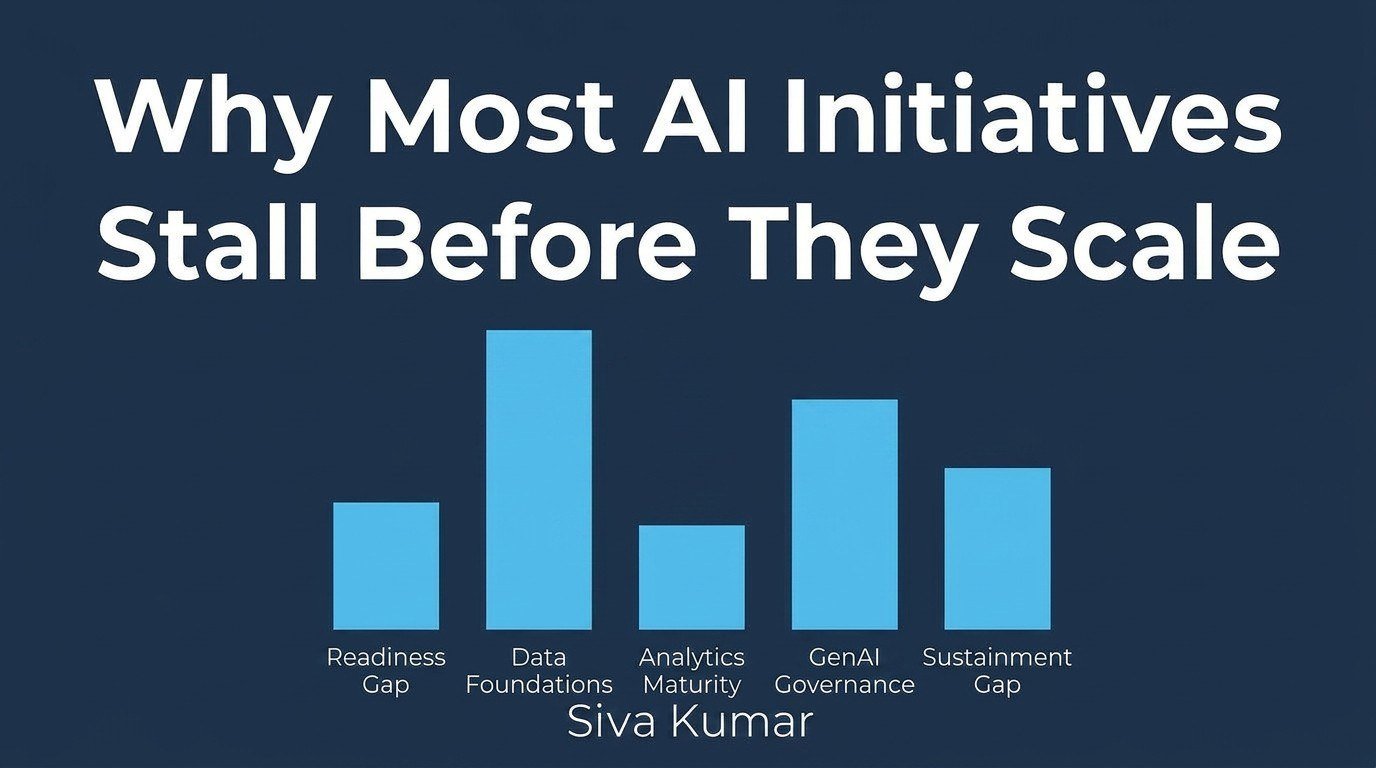
Over three decades leading large-scale enterprise transformations across banking, insurance, energy, and retail, I keep seeing the same five structural gaps that stop AI from scaling.
Industries change. Architectures differ. Leadership teams vary. Tier-1 banks, global insurers, energy majors, retail conglomerates — regulated and non-regulated environments alike. The pattern does not.
If you are responsible for funding, leading, or governing AI programs in your organization — this article is a direct diagnostic. Not a technology briefing. Not a vendor roadmap. A practitioner’s pattern recognition across three decades of enterprise transformation, anchored in research and tested in regulated environments. It outlines the five structural gaps that stop AI from scaling — unfunded readiness, fragile data foundations, analytics shortcuts, GenAI deployed without governance, and teams built to deploy but not sustain — what the evidence says about each, and the executive disciplines that close them.
The gap between organizations scaling AI responsibly and those funding expensive experiments is widening — and the research confirms it is structural, not sectoral.
AI rarely fails because the model is bad.
It fails because the organization that must use the model is not ready.
This is not a technology problem — it is an organizational problem. And in my experience — and in the research from UC Berkeley and UT Austin that I studied formally — it shows up in five predictable gaps.
There is also a pattern to what actually works. I will come back to that after outlining each gap.
You funded the model. Nobody funded the readiness.
The most expensive AI failure does not happen in production — it happens in the business case meeting where nobody asks whether the organization is ready to act on what the model produces.
Business leaders expect AI to work like a skilled analyst — ask a question, get a reliable answer. Technology leaders know the answer is only as reliable as the data, the integrations, and the model governance beneath it.
When those two mental models collide mid-program — and they always do — the result is familiar: lost confidence, lost sponsorship, and another AI initiative that never scales beyond pilot.
In practice, more AI programs are funded for optics than for outcomes. The business case describes a transformation. The governance structure funds a demo.
UC Berkeley's framework for enterprise transformation gives us the right diagnostic lens: People, Process, Technology, and Data.
Most organizations over-invest in Technology and under-invest in the other three. The ratio that actually works is closer to 40% Data, 30% Process and People, 30% Technology — the inverse of what most programs actually do.
That inversion is predictable and avoidable. Technology investment is visible, measurable, and easy to present to a board.
Data governance, process redesign, and people capability are slower, less visible, and harder to put in a business case. So they get deferred — and the technology is deployed on a foundation that was never built.
Addressing this gap starts with outcome-based business cases that name the business outcome, adoption KPI, and post-deployment owner before a dollar is committed. Executive sponsors need post-deployment accountability — not just delivery accountability. Pre-funding readiness checklists that require a data baseline, guardrails plan, and monitoring framework close the gap between what the business expects and what the technology can deliver. The deep dive on expectation alignment — including joint scoping frameworks, adoption incentive design, and the governance questions every executive sponsor must answer before funding — is the subject of the first dedicated article.
Fragile data foundations — expensive failure follows.
Most organizations believe their data problem is a technology problem. It is not. It is a governance problem that no technology budget can solve.
Data for AI is not just internal structured records from ERP, supply chain, or finance systems. It is external market, pricing, and reference data. It is unstructured data — emails, documents, customer interactions, operational logs, field reports.
And critically, it is the relationships between all of these — which only become visible when the data is integrated, governed, and clean.
The scale of this problem is well documented. Gartner (February 2025) found that 63% of organizations either lack or are unsure they have the right data management practices for AI — and predicts that through 2026, organizations are projected to abandon up to 60% of AI projects unsupported by AI-ready data. Separately, research by Precisely and Drexel University’s LeBow College of Business found that only 12% of organizations report their data is of sufficient quality and accessibility for effective AI implementation. These are not outliers — they are the baseline condition that most enterprise AI programs start from.
The financial services context makes this concrete in a way that every banking and insurance executive will recognize.
Data Types and Integration Risk
UEBA — User and Entity Behavior Analytics — is one of the most strategically important AI applications in financial services. It uses machine learning to detect insider threats, compromised accounts, and anomalous behavior across the enterprise. It is also one of the most data-hungry AI deployments an organization can undertake.
A UEBA model needs structured data — transaction logs, authentication events, network flows, access records. It needs unstructured data — email metadata, document access patterns, communication behavior.
It needs external data — threat intelligence feeds, industry benchmarks. And it needs integrated data — identity management, HR systems, trading platforms, and core banking all feeding the same model, consistently, in real time.
UEBA illustrates the data complexity challenge that applies to every enterprise AI system — the model is only as reliable as the data feeding it. In organizations where the data foundation has not yet been addressed, here is what plays out.
The model builds its behavioral baseline on noisy, incomplete data. It learns what normal looks like — but what it is learning is a noisy, incomplete version of normal. The baseline is wrong before the detection begins.
Then the false positives start. The signal-to-noise ratio is poor, and the model cannot reliably distinguish genuine anomalies from data inconsistencies. Security teams, overwhelmed by alerts, begin to ignore them. The UEBA system is running. But the security team has been conditioned to dismiss what it says.
This is the most dangerous failure mode in enterprise AI: not a model that misses threats, but a team conditioned to ignore its alerts. An AI adoption failure caused entirely by a data quality failure upstream.
Organizations that invest in the data foundation first avoid this pattern entirely. UEBA deployed on clean, integrated, well-governed data delivers exactly what it promises — reliable behavioral baselines, trustworthy alerts, and security teams that act on what the model tells them. The maturity journey is real. The destination is achievable. But the sequence matters. The same pattern plays out in AML transaction monitoring, credit risk modeling, and regulatory reporting automation — across sectors, across geographies, across maturity levels. Different use cases. Same structural gap when the data foundation is skipped.
Addressing this gap starts with data contracts that define schema, ownership, SLAs, and quality expectations between producers and consumers. Automated data quality and lineage tooling makes datasets traceable and trustworthy. Named data stewards with remediation accountability ensure that when quality checks fail, there is a named owner and a deadline for resolution. The deeper data foundation playbook — including synthetic data strategies, privacy-preserving augmentation, critical dataset prioritization, and the governance architecture that makes AI-ready data sustainable — will be covered in full in the dedicated Gap 2 article in this series.
The analytics shortcut that always backfires.
Buying a prescriptive AI system before the organization can reliably describe what happened yesterday is not ambition. It is a well-funded way to build the wrong thing.
The journey from data to AI runs through three stages:
Each stage requires the previous one to be working reliably before the next can be trusted. Most organizations want to jump directly to prescriptive. The business case is written around prescriptive outcomes. But the data foundation is still at descriptive — or not even there yet.
We built this sequentially. Descriptive dashboards first — creating operational visibility and establishing data quality discipline as a side effect of building reports people actually used. Predictive models next — built on data that had already been cleansed through the descriptive phase. Then prescriptive recommendations — automated actions within defined parameters, with human oversight at every boundary.
A/B testing was essential throughout — not just for the models, but for the operating model changes that AI-driven decisions required. When a model recommends an action, test it against a control group before operationalizing it at scale. Organizations that skip this step build a very confident machine for making systematic mistakes efficiently.
The first move is mandating descriptive foundations before predictive work begins — operational dashboards and reporting that create data quality discipline as a side effect of building tools people actually use. A/B testing prescriptive recommendations against defined business KPIs treats AI outputs as product experiments before they become operational decisions. Gating progression through descriptive → predictive → prescriptive with formal sign-off prevents the shortcut that most programs attempt and most programs regret. The full analytics sequencing playbook — experiment design standards, human-in-the-loop requirements, and the maturity gating model — goes deeper than this article can.
GenAI without boundaries is a liability, not an advantage.
GenAI deployed without a governance boundary does not create competitive advantage. It creates liability at scale.
GenAI is not a replacement for structured AI. It is a different tool for a different class of problems — valuable for knowledge access, document summarization, and customer-facing content generation. It is not appropriate for autonomous operational or regulatory decisions where accuracy, auditability, and explainability are mandatory — though with proper human oversight and governance guardrails, it can augment regulated workflows in carefully defined roles.
Gartner (July 2024) predicted that at least 30% of GenAI projects would be abandoned after proof-of-concept — not because the technology failed, but because the governance and data foundations were not in place to support production deployment. That is not a technology failure. It is an organizational readiness failure, which is exactly the pattern this article describes.
The numbers on governance readiness are sobering. A Gartner survey of IT leaders in Q2 2025 found that only 23% are very confident in their organization’s ability to manage security and governance when deploying GenAI tools — yet the same research shows that organizations which perform regular audits and assessments of their AI systems are over three times more likely to achieve high GenAI value than those that do not (Gartner, 2025). Governance is not a constraint on GenAI value. It is the condition for it.
The governance boundary between where GenAI is appropriate and where it is not requires deliberate design. It does not emerge by default. Organizations that deploy GenAI without this boundary decision find they have democratized output without democratizing accountability — a governance risk that surfaces slowly and expensively. Gartner is unambiguous on this point: without explainability and model observability, GenAI cannot mature beyond controlled lab environments.
In regulated financial services, this is not a preference. It is a compliance requirement. Banking regulators globally are increasingly expecting institutions to demonstrate that AI-driven decisions are explainable, auditable, and governed. This includes Canada’s OSFI, the UK’s FCA, and the EU AI Act — and equivalents across APAC and other jurisdictions. The organizations building those frameworks now will be ahead of the regulatory curve. The ones waiting will be reactive. By 2030, AI regulation is projected to extend to 75% of the world’s economies — making governance a strategic investment, not a compliance cost (Gartner, 2026).
This governance obligation extends beyond model explainability into data privacy. Organizations deploying AI models across multiple geographies must ensure their training data, inference data, and model outputs comply with the privacy regime of every jurisdiction involved — GDPR in the EU, PIPEDA and Bill C-27 in Canada, and equivalent privacy frameworks across APAC and the Americas. Data bias compounds this further: a model trained on historically skewed data inherits and amplifies those inequities at scale, creating simultaneous data governance, model governance, and regulatory risk. These are not separate workstreams. They are the same governance problem viewed from three angles — and the follow-up article in this series will go deeper on each.
Even with emerging agentic AI and workflow-orchestrated systems, the same constraints apply — without governed data, clear guardrails, and operational readiness, autonomy simply accelerates failure.
Addressing this gap starts with defining explicit GenAI boundaries and risk tiers — classifying use cases by consequence and setting permitted behaviors per tier. Provenance logging, confidence thresholds, and human review checkpoints for consequential outputs close the governance gap between deployment and accountability. Third-party models must be treated as supply-chain items with contractual audit rights, not black boxes where accountability is outsourced along with the API call. Regular red-team and adversarial testing cycles surface failure modes before regulators or customers do. The full GenAI governance playbook — boundary design, vendor model controls, and the compliance architecture for regulated environments — will follow in the next dedicated article.
Built to deploy. Forgotten to sustain.
The organization that deploys AI without addressing team readiness has not transformed. It has automated its existing problems.
Technology readiness and organizational readiness are not the same thing. Berkeley’s research on AI team structure identifies a consistent pattern in failed programs: the team that builds the AI is not the team that sustains it. Sustainable adoption requires business leaders who can challenge model outputs on business grounds, data scientists who understand the business problem not just the model metric, and operational teams who know when to override the system. That last capability — knowing when to override — is the operational definition of AI literacy.
Three readiness dimensions consistently determine whether an AI program sustains value after deployment. Each is addressed briefly here — each will be explored in depth in the follow-up articles in this series.
Cross-functional alignment
Business, marketing, and sales teams want outcomes. Technology teams build models. When neither side fully understands the other’s constraints — clean data requirements, business case clarity, success definition — the program stalls after deployment. This is the most common and least discussed failure mode in enterprise AI.
Model performance, measurement, and continuous learning
A model that performs well at deployment will drift as real-world conditions change. Sustaining AI value requires a continuous feedback loop: defined KPIs, regular performance reviews, drift detection, and a retraining cadence embedded in the success criteria from the outset. Deployment is not the finish line. It is the starting point of an ongoing operational commitment.
Cultural adoption and AI literacy
Change readiness for AI is not measured by training module completion. It is measured by whether the organization has developed the collective judgment to use AI well — including knowing when not to use it. Role-specific literacy programs, transparent communication about what AI is changing, and feedback loops that make model performance visible to the people who depend on it are the operational requirements, not the optional extras.
What changes the outcome here is a clear ownership table for every deployed model — business owner, data steward, MLOps owner, and the single business KPI that defines success. Living model playbooks and incident runbooks with monitoring signals, rollback triggers, and escalation paths make sustainment operational rather than aspirational. Cross-functional sustainment squads that include product, operations, data, and compliance replace the project team mindset that ends at go-live. The full operational readiness playbook — including literacy frameworks, override training design, and the sustainment squad model — will be covered in the dedicated Gap 5 article in this series.
The Governance Thread
“Governance is not a compliance checkbox — it is the operating system for safe, scalable AI.”
Governance runs as a cross-cutting thread beneath all five gaps. It is not a sixth gap — it is the discipline that determines whether the foundations hold. Six dimensions define the governance operating system that every organization scaling AI must eventually address:
Risk tiering. Classify AI systems by consequentiality so that controls scale with impact rather than applying uniform overhead to every deployment.
Provenance and audit trails. Trace training data, model inputs, and outputs with immutable records that satisfy both internal accountability and external regulatory requirements.
Ethics and bias management. Bias is operational, not a one-time deployment check. Continuous monitoring, regular bias audits, and defined remediation processes are the minimum standard.
Data privacy and cross-border provenance. Consent architecture, data lineage, and jurisdictional compliance for training and inference data across every geography where the model operates.
Third-party model and vendor governance. Pre-trained models and APIs are supply-chain items. Contractual audit rights, usage constraints, and retraining clauses are not optional.
Board reporting and executive escalation. A concise AI system inventory and a tested incident escalation path so leadership can act when something goes wrong — not learn about it from a regulator.
Governance is the operating system for safe, scalable AI — the executive playbook covering risk tiers, mandatory artifacts, vendor controls, and a one-page board briefing is coming as a dedicated article in this series.
This article is advisory and not legal advice; consult counsel for jurisdiction-specific compliance requirements.
Recognizing these five gaps is the diagnostic. What follows is the funding and delivery discipline that actually closes them.
What Works in Practice
The right entry point depends on where an organization sits in its maturity journey. The diagnostic question is not ‘what AI should we build?’ but ‘which of the five gaps is our primary constraint right now?’ For most organizations, it is Gap 2 — the data foundation. For others who have addressed data, it is Gap 3 — analytics sequencing. For those deploying GenAI, it is Gap 4 — governance boundaries. The practical guidance below applies regardless of where you start — but the sequence in which you apply it should follow your organization’s actual maturity, not the order in a vendor’s roadmap. UC Berkeley’s People/Process/Technology/Data lens and UT Austin’s scaling research converge on one practical insight: invest differently. Most programs over-allocate to technology and under-invest in data, process, and people. The 40/30/30 allocation principle above is the right starting point — but the ratio only holds if three strategic requirements are met before the program is funded.
Defined scope and pilot design
The organizations that scale AI start with a bounded problem, a named environment, and a measurable timeframe — not a platform strategy. A 13-week pilot across 20–30 locations with one defined use case and one measurable outcome is not a limitation. It is the proof-of-concept discipline that separates organizations that scale AI from those that run expensive experiments indefinitely. If the business case cannot describe the scope in two sentences, it is not ready to be funded.
Concrete KPIs and success criteria
Revenue impact. Risk reduction. Operational velocity. These are the success criteria that belong in an AI business case — not model accuracy, precision, or F1 scores. If the executive sponsor cannot read the success criteria and immediately understand whether the program delivered, the measurement framework is wrong. The question is not whether the model performed. It is whether the business outcome the model was built to deliver actually materialized.
Cost, ROI, and operational readiness
What is the total investment? What is the expected return and payback timeline? And critically — is the organization operationally ready to act on the output? A model that produces the right recommendation into a team that has not been prepared to receive it delivers no return. The cost of the model is only part of the investment. The cost of the change management, the data foundation, and the governance architecture that makes the model usable is the other part — and it is almost always underestimated.
Underpinning all three requirements is the operational architecture that makes them deliverable: guardrails that define where AI acts autonomously and where humans decide; a data and privacy baseline that ensures every model input is lineaged, governed, and auditable; and an MLOps (Machine Learning Operations) discipline that treats every deployed model as a living system — monitored for drift, continuously retrained, and measured against business outcomes rather than technical benchmarks. These are not implementation details. They are the conditions under which the three strategic requirements can actually be met.
The Question That Matters
After twenty-five years in the field across enterprise and financial services transformation, and formal study at UT Austin and UC Berkeley — one question has become my first filter for any AI business case.
Not 'is the technology ready?'
The technology is ready.
'Is the organization ready to use it?'
The answer is rarely binary. Most organizations are partially ready — strong on some dimensions, exposed on others. The five gaps in this article are the diagnostic framework. They reveal not just whether an organization is ready, but which foundations need to be built first, in what sequence, before the technology can deliver what the business case promises.
Data foundation. Analytics maturity. GenAI governance. People, ethics, and compliance. Measurement discipline. Five dimensions. None of them are technology problems. All of them are leadership problems.
If you fund an AI pilot, require three things in the business case: a clear operational guardrail plan, a verifiable data and privacy baseline, and an outcome-based MLOps measurement framework. Without them, you are funding a demo — not a transformation.
Agentic AI, autonomous workflows, and self-optimizing systems will only amplify this reality. These technologies do not remove the need for data quality, governance, and human oversight — they increase it. The organizations that treat AI as an operational system, not a technical experiment, will be the ones that scale safely. The ones that don’t will discover that autonomy without readiness doesn’t eliminate risk. It compounds it.
Over the next few weeks, I will go deeper on each of these gaps — the sequencing, the disciplines, and the governance playbook that underpins all five. If this framing resonates, follow the series.
What is the biggest blind spot in your organization’s AI program right now? Share your perspective in the comments. Or DM me directly to discuss the structural gaps in your current AI funding cycle.
The views expressed in this article are the author’s own and do not represent the views of any current or former employer, client, or institution.